
Water Balance & Water Quality Modelling
Water quality predictions you can defend.
Water quality models set effluent limits, size treatment plants and drive closure costs. Reviewers will test every link between your source terms and your predictions. We test them first.
We build in a fixed order. Conceptual model and boundaries. Source terms. A GoldSim site-wide water balance and water quality model. Then calibration and uncertainty analysis. Every step is documented, so the model can be reviewed, updated and handed over without guesswork. Nothing is hidden in a spreadsheet.
Source terms come from kinetic tests and site monitoring, scaled to field conditions with stated assumptions for temperature, particle size, contact water, flushing and oxygen supply. Where secondary minerals cap concentrations, PHREEQC sets the solubility limits. We confirm those limits still hold as pH, redox and ionic strength shift.
Sensitivity runs, probabilistic or bounding cases and climate scenarios show which inputs drive the answer. Model effort matches the decision: a screening model for early water management choices, a fully calibrated model when predictions will set permit limits or treatment capacity.
The model doesn't retire after permitting. As monitoring data come in, we recalibrate and update the predictions, so it stays a working tool through operations and closure. Predictions improve as the mine matures.
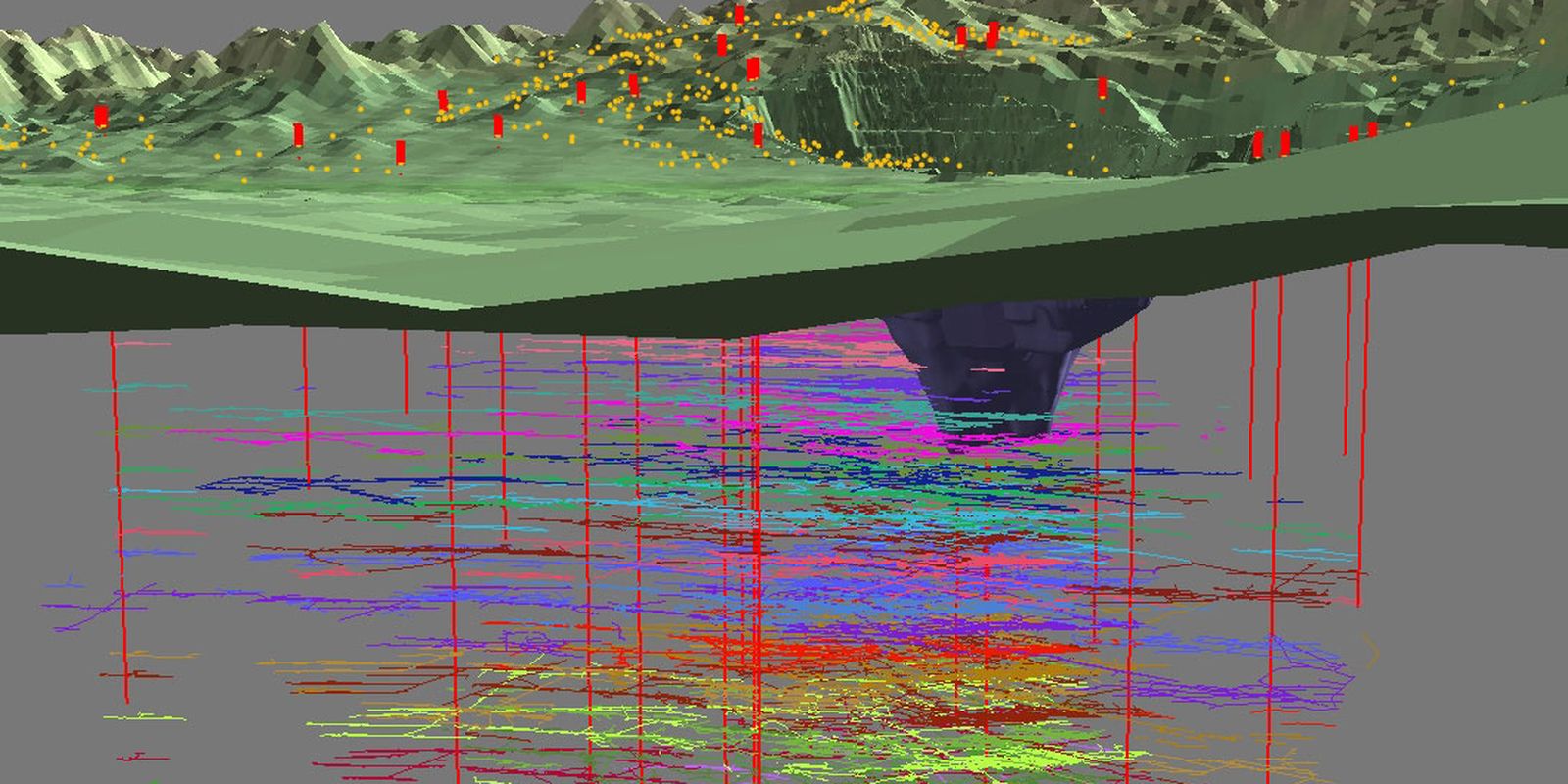 3D terrain, pit and drillhole modelNorthwest British Columbia · Water Balance & Water Quality Modelling
Our Services
Source-Term Development and Calibration
Source terms built from kinetic tests and monitoring data. Every scaling assumption documented and, where data exist, calibrated to the field.
Site-Wide Water Balance and Water Quality Modelling
GoldSim models of your facilities, flow paths and timing, structured so a reviewer can follow each load from source to receptor.
Speciation and Solubility Modelling
PHREEQC defines solubility controls, mixing and speciation. We check those controls hold as conditions change.
Climate and Uncertainty Analysis
Wet, dry and climate-change scenarios with sensitivity and probabilistic analysis. You know how far each decision can be trusted.
Treatment Design Inputs
The flows, loads and timing your engineers need to size treatment and storage.
Independent Model Review
Third-party models checked for structure, source-term defensibility and fitness for the decision they support.
Questions we help you answer
- Which source, and which constituent, drives the receiving-environment prediction?
- Do the source terms match the kinetic data and site monitoring?
- How sensitive is the answer to scaling factors and solubility assumptions?
- When will treatment be needed, and for how long?
- Is this model fit for the decision it supports?
Supporting your decisions
| Stage | Decision | DHT input |
|---|---|---|
| Feasibility | Water management design and treatment need | Preliminary site-wide model and source terms |
| EA / permitting | Predicted effects and proposed effluent limits | Calibrated model with sensitivity and uncertainty cases |
| Detailed design | Treatment capacity and water storage | Design flows, loads and scenarios |
| Operations | Adaptive management and model updates | Recalibration against monitoring data |
| Closure | Closure water quality and financial assurance | Long-term predictions and treatment duration |
Related services
Collaborate with DHT
Tell us what you're facing. We'll tell you how we can help.