Contaminated Sites & Legacy Mines
Clear answers for legacy liabilities.
Legacy mines and contaminated sites come with thin records, pathways that have shifted for decades and receptors that may already be affected. We bring operating-mine discipline to the conceptual site model and find which source, pathway and receptor links drive the risk. And which ones don't.
Each investigation phase answers one question. Phase I sets out site history and areas of potential concern. Phase II and III programs characterize soil, sediment, groundwater and surface water, define the extent of contamination and feed the risk assessment. No phase runs longer than it needs to.
Natural mineralization is common at mine sites, and it can move the remediation target entirely. Our geochemical interpretation separates mine-related loading from natural background, so the budget goes where it cuts the most risk.
We rank remedial options on effectiveness, durability, cost and long-term care. The range runs from source removal and covers to permeable reactive barriers, passive treatment and monitored natural attenuation. For portfolios of abandoned mines, we help direct limited budgets to the sources doing the most damage downstream.
Where long-term care is unavoidable, we define the monitoring, maintenance and contingency measures it needs. You get what you need to cost it with confidence, for as long as the obligation lasts.
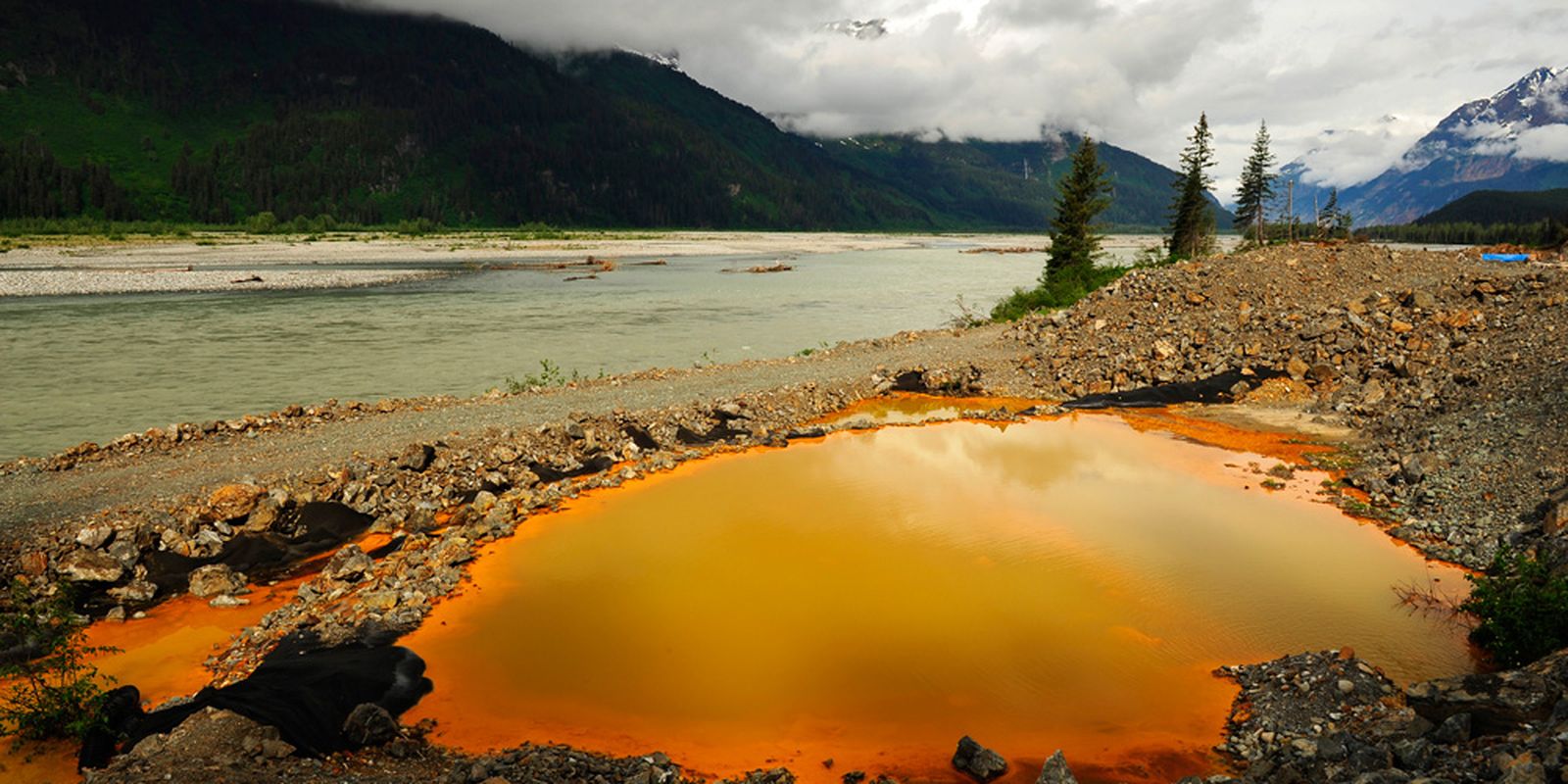 Acid rock drainage beside a riverNorthwest British Columbia · Contaminated Sites & Legacy Mines
Our Services
Phase I–III Environmental Site Assessment
Staged assessments that build a clear picture of contamination: its sources, its extent and its pathways.
Background and Natural Mineralization Evaluation
What is natural and what came from the mine. Remediation targets that are realistic and defensible.
Risk Assessment Support
The geochemical and exposure-pathway inputs that human health and ecological risk assessors need.
Remedial Options Analysis and Planning
Options compared on effectiveness, durability and cost, and a remedial action plan for the one that wins.
Passive Treatment and Reactive Barrier Evaluation
Passive treatment systems and permeable reactive barriers evaluated, drawing on our published work on reactive barriers for groundwater metal remediation.
Legacy Mine Reclamation and Long-Term Care
Reclamation, monitoring and maintenance defined for legacy sites, with the information needed to cost them.
Questions we help you answer
- Which sources and pathways are active at this site?
- How much of the contamination is natural mineralization?
- Which remedial option cuts the most risk per dollar?
- Is natural attenuation enough, and can we prove it?
- What will long-term care involve, and what will it cost?
Supporting your decisions
| Stage | Decision | DHT input |
|---|---|---|
| Investigation | Scope and sequence of characterization | Staged ESA programs and data gap analysis |
| Risk assessment | Linkages requiring action | Conceptual site model and pathway inputs |
| Remediation | Choice of remedial approach | Options analysis and remedial action plan |
| Long-term care | Monitoring and maintenance obligations | Long-term care plan and cost inputs |
| Transaction | Environmental liability in a property transfer | Phase I–II assessment and liability review |
Related services
Collaborate with DHT
Tell us what you're facing. We'll tell you how we can help.